
 TECHNICAL INSIGHT · TURBINE CONTROL FLUID
Donaldson Hy-Pro FSA: Conditioning phosphate-ester fluid in steam-turbine EHC systems
In a steam-turbine train, phosphate-ester fluid is commonly selected for electro-hydraulic control (EHC) because of its fire-resistant properties. Its health cannot be managed by appearance or mechanical filtration alone: water, acids, degradation products and dissolved metals can affect resistivity and form gels or deposits that threaten servo-valve performance. Donaldson Hy-Pro’s FSA is an offline conditioning skid designed specifically for phosphate-ester fluid—not a universal purifier for every oil circuit.
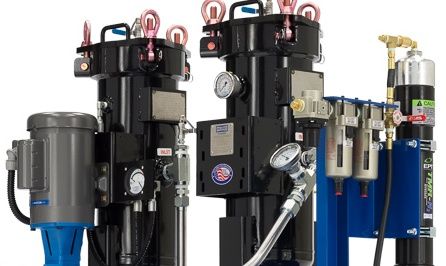
Donaldson Hy-Pro FSA phosphate-ester conditioning skid. Product image from the manufacturer.
What is EHC, and why does fluid condition matter?
Electro-hydraulic control converts electrical commands into hydraulic force to position turbine valves. Pumps, servo valves, piping and actuators depend on fluid that is clean, dry and electrically suitable. Particles or deposits can obstruct fine metering clearances; water and degradation products can raise acid number (AN), lower resistivity and create gels or deposits on control components. Potential consequences include slow or erratic valve response, plugged filters, increased maintenance and risks to unit availability. [4]
How FSA treats the fluid
FSA is an offline kidney-loop skid: it draws a controlled side stream from the EHC reservoir, conditions it through dedicated media and returns it to the tank. A typical arrangement combines VTM media for particles, water and insoluble oxidation products with ICB ion-exchange media for molecular removal of acids, degradation products, gels/deposits and dissolved metals. It complements the EHC pressure and servo-pilot filters; it does not replace them, nor does conditioning guarantee complete reclamation of fluid in every condition. [1][2][3]
Two distinct mechanisms: VTM and ICB®
The manufacturer specifies VTM particulate media at β₃[c] ≥ 4,000 for particles, insoluble oxidation by-products and water. ICB® is an ion-exchange/ion-charge-bonding resin intended to remove acids and dissolved degradation products, gels/deposits and dissolved metal ions, supporting chemical cleanliness and phosphate-ester resistivity. The functions are complementary: mechanical filtration captures particles, while ICB targets dissolved contaminants that a conventional particulate element cannot capture. Verify actual performance using comparable pre- and post-treatment samples and consistent methods. [2][3]
TMR-N₂: managing moisture and oxygen at the reservoir
Some configurations integrate a TMR-N₂ headspace dehydrator. Donaldson Hy-Pro describes continuous nitrogen introduction through the reservoir headspace to help remove water vapour and thermal-breakdown gases while limiting oil contact with oxygen. The intent is both to condition fluid and slow ongoing degradation. Evaluate nitrogen supply, ventilation and gas safety, reservoir design and off-gas handling; do not assume every FSA package includes this option. [1][2]
Models and preliminary sizing
The manufacturer lists nominal flow selections of approximately 0.5, 1, 2 and 4 gpm (about 1.9, 3.8, 7.6 and 15.1 L/min). Reference maximum reservoir sizes for FSA05/FSA1/FSA2/FSA4 are approximately 750/1,500/3,000/6,050 L. These values screen a model; they are not sufficient for final selection. Consider fluid volume and condition, treatment time, viscosity and temperature, circulation demand, operating regime, suction/return arrangement and the exact phosphate-ester fluid. Confirm compatibility with the manufacturer for polyol ester or other synthetics; not every fire-resistant fluid is interchangeable. [2]
Operating value—and limitations
Where fluid remains treatable and contamination sources are controlled, FSA is intended to reduce water, acid, particles and degradation products; support resistivity; limit gel/deposit formation; and improve conditions for servo valves. This can give the plant a condition-based maintenance option and may help avoid premature oil replacement, bleed-and-feed or costly flushing. It is not a guarantee against every trip, unlimited fluid life or a substitute for fixing water ingress, air/dust contamination, overheating, incompatible seals or inadequate maintenance. Severely degraded fluid may still require replacement or an OEM-approved flush. [1][3][4]
A data-led assessment and acceptance plan
Before recommending a package, identify the exact fluid brand/grade and top-up history; obtain representative samples using the plant’s sampling procedure; and assess at least AN, water, particle cleanliness and—where applicable—resistivity, with dissolved metals or deposit/patch tests as warranted by the monitoring program. Survey reservoir volume, suction/return points, sampling locations, pressure drop, temperature, 50-Hz power, footprint, spill containment and hazardous-area classification. After installation, establish a baseline, verify leaks, rotation, flow and differential pressure, then trend samples against agreed acceptance and element-change criteria. Do not size from tank volume or a single AN result alone. [2][4]
Power-plant applications and SuperMRO’s role
FSA’s primary application is fire-resistant phosphate-ester fluid in steam-turbine EHC systems, making it relevant for thermal plants whose turbine control system uses this fluid, whether coal- or gas-fired. It should not be assumed suitable for turbine bearing lube oil, mineral hydraulic oil, diesel or every fire-resistant fluid. SuperMRO can coordinate with the plant and manufacturer to review fluid data, installation constraints, compatibility, sizing, sampling and an integration/maintenance plan. Final model selection and expected results must be validated against the specific system.
Thuật ngữ đọc nhanh
| Thuật ngữ | Giải thích |
|---|---|
| EHC | Steam-turbine electro-hydraulic control. |
| Phosphate ester | Synthetic fire-resistant hydraulic fluid commonly used in EHC; wetted materials must be compatible. |
| AN / Acid Number | Acidity measure, commonly expressed as mg KOH/g; trend it using a consistent test method. |
| Resistivity | A fluid’s opposition to electrical current; relevant to servo-valve reliability in some EHC systems. |
| Kidney-loop | An auxiliary circulation loop that draws fluid from a reservoir, conditions it and returns it. |
| Bleed-and-feed | Removing a portion of old fluid and replenishing it with new fluid. |