
 TECHNICAL INSIGHT · FLANGE MAINTENANCE
Enerpac SWi hydraulic flange spreaders: controlled separation for safer pipework maintenance
When a gasket must be replaced, sealing faces inspected, a blind removed or pipework serviced, the gap between flange faces must be created and held under control. Enerpac’s Equalizer SWi range uses a stepped wedge with hydraulic actuation to spread flanges from a narrow access gap. Its value is not simply the rated force: correct positioning, balanced opening and transferring the load to mechanical safety blocks before work begins are essential.
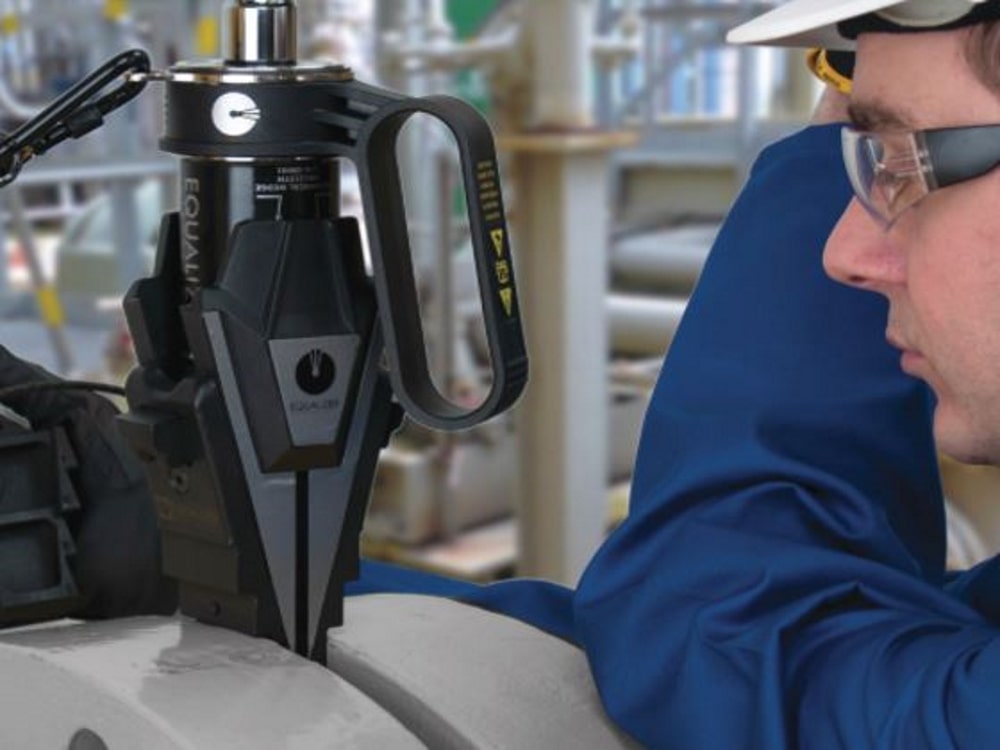
Field photograph of a technician using a hydraulic flange-spreading wedge. Image source: Enerpac.
The maintenance problem: creating a controlled gap
Flanged joints are common in steam, water, oil, gas and chemical services and in removable equipment assemblies. During an outage, a crew may need to replace a gasket, clean or inspect sealing faces, install a blind or spectacle blind, align pipework, or remove a valve or component. An SWi wedge applies force directly between flange faces and opens the joint in measured steps, avoiding improvised prying or packing. Use only after the line has been isolated, depressurized, drained and verified safe under the plant’s energy-control procedure. The tool is not intended to open a joint that remains pressurized or subject to unassessed loads.
How SWi works: stepped wedge and hydraulic actuation
Thin stepped jaws enter an existing access gap. As the actuator moves, the wedge surfaces separate the two flange faces. SWi5TE uses an external hydraulic cylinder connected to a pump and hose; SWi5TI integrates the hydraulic actuation on the tool, which can simplify set-up where hose routing or space is restricted. Larger SWi20/25 models also offer external or integral hydraulic variants. The catalogue lists up to 10,000 psi (700 bar) for hydraulic configurations. This is a system pressure limit, not a way to calculate usable joint-separation force without matching the correct model, cylinder, pump and accessories. [1][2]
Model range and reading the ratings
The catalogue rates SWi5TE/SWi5TI at up to 8.7 tons of spreading force per tool, with up to 4 inches (about 102 mm) of spreading distance and a 0.16-inch (4 mm) minimum access gap. SWi20/25TE/TI models are rated up to 27 tons per tool, up to 4.1 inches (about 104 mm) of spread and a 0.24-inch (approximately 6 mm) minimum gap. These are catalog limits dependent on the selected jaw/stepped-block configuration, not design loads for every flange. Enerpac requires at least two tools on a joint to help maintain an even gap. Do not multiply a single-tool rating to infer flange capacity: load distribution also depends on flange size and class, stiffness, corrosion, tool placement and the restraint in the connected piping. [1][2]
Selecting a set: external or integral hydraulics?
External-hydraulic TE sets let the pump sit in a convenient location and connect through a hose. Depending on the kit number, sets may include one or two wedges, a hand pump, gauge, hose, safety blocks, stepped blocks and a tether. Integral-hydraulic TI tools are more self-contained at the work point and may help where access or hose placement is difficult. Selection should compare the measured starting gap, jaw contact thickness, required separation, load, tool orientation, room for the pump or hose, weight and drop-prevention method. Kit contents differ by order code: verify the bill of materials for the exact part number instead of assuming every set contains two tools or a pump and hose. [2][3]
Work sequence and the role of safety blocks
Review the joint and line condition first; verify isolation and depressurization, inspect the flange and choose tool positions around the joint. The SWi instructions call for at least two tools and at least two opposing bolts left in place and suitably loosened to help limit lateral movement. For SWi5TE/SWi5TI, the minimum access gap is 4 mm; insert the full width of the selected jaw step to its heel. Once the desired opening is reached, or the tool reaches its travel limit, insert the matching safety block and gradually transfer the flange load from the wedge to the block. Only then proceed with permitted flange work. Keep hands and other body parts out of the gap; hydraulic pressure must not be relied on to support the opening during work. To open further, unload and retract the tool, reposition it at the next step and repeat as directed. [1]
Typical applications and limits to check
The SWi range may be evaluated for thermal power, petrochemical, chemical, steel, cement, pulp and paper, mining, water-treatment and other plants with flanged pipework or valve assemblies requiring maintenance. Typical tasks include gasket replacement, blind installation/removal, joint inspection, cleaning and alignment support. Suitability depends on flange dimensions and class, access gap, material and corrosion condition, residual pipe loads, required separation force, contact temperature and site safety rules. The L4390 instructions limit hydraulic-tool jaw contact temperature to 70°C; cool the equipment or assess another method if this limit is exceeded. ATEX approval applies only to the specific EX-coded models and must not be assumed for every SWi tool. [1][2]
Field assessment, acceptance and maintenance
A sound proposal starts with joint data: flange standard and size, pressure class, gasket type, measured access gap, required opening, bolt layout, pipe loads and isolation sequence. Then match the model, tool count, blocks, pump and hose to the task and access conditions. Before each job, inspect the body, wedge tips, couplers, hoses, gauge, pump, tether and safety blocks; use only hydraulic components with compatible pressure ratings. After use, clean, lubricate as directed, inspect for wear or damage and record the condition. SuperMRO can help review the requirement, match an SWi configuration and accessories to site conditions, supply the equipment and support application and maintenance guidance based on the manufacturer’s instructions. The plant’s engineering and safety owners must approve the final method.
References · Term
| Term | Explanation |
|---|---|
| SWi | Enerpac Equalizer range of flange-spreading wedge tools. |
| TE / TI | TE: external hydraulic actuation. TI: hydraulic actuation integrated into the tool. |
| Access gap | Initial clearance between flange faces into which the wedge step is inserted. |
| Spreading distance | Tool travel/opening for a configuration; larger openings may require repeated steps with safety blocks. |
| Safety block | Stepped mechanical block that carries load after opening; it does not replace structural/load assessment. |
| Lanyard | Tether that connects the tool to a suitable anchor to reduce drop risk. |