
 COOPERATION & SOLUTIONS · 21 OCTOBER 2026
SuperMRO and IBS Saigon: iBrite lighting and Hisense central air-conditioning solutions
Having developed within the IBS ecosystem, SuperMRO and IBS Saigon now operate independently, focusing on their respective strengths while continuing to collaborate. They are cooperating on lighting products and solutions distributed by IBS Saigon, particularly iBrite, and introducing Hisense HVAC to both companies’ customers and partners.
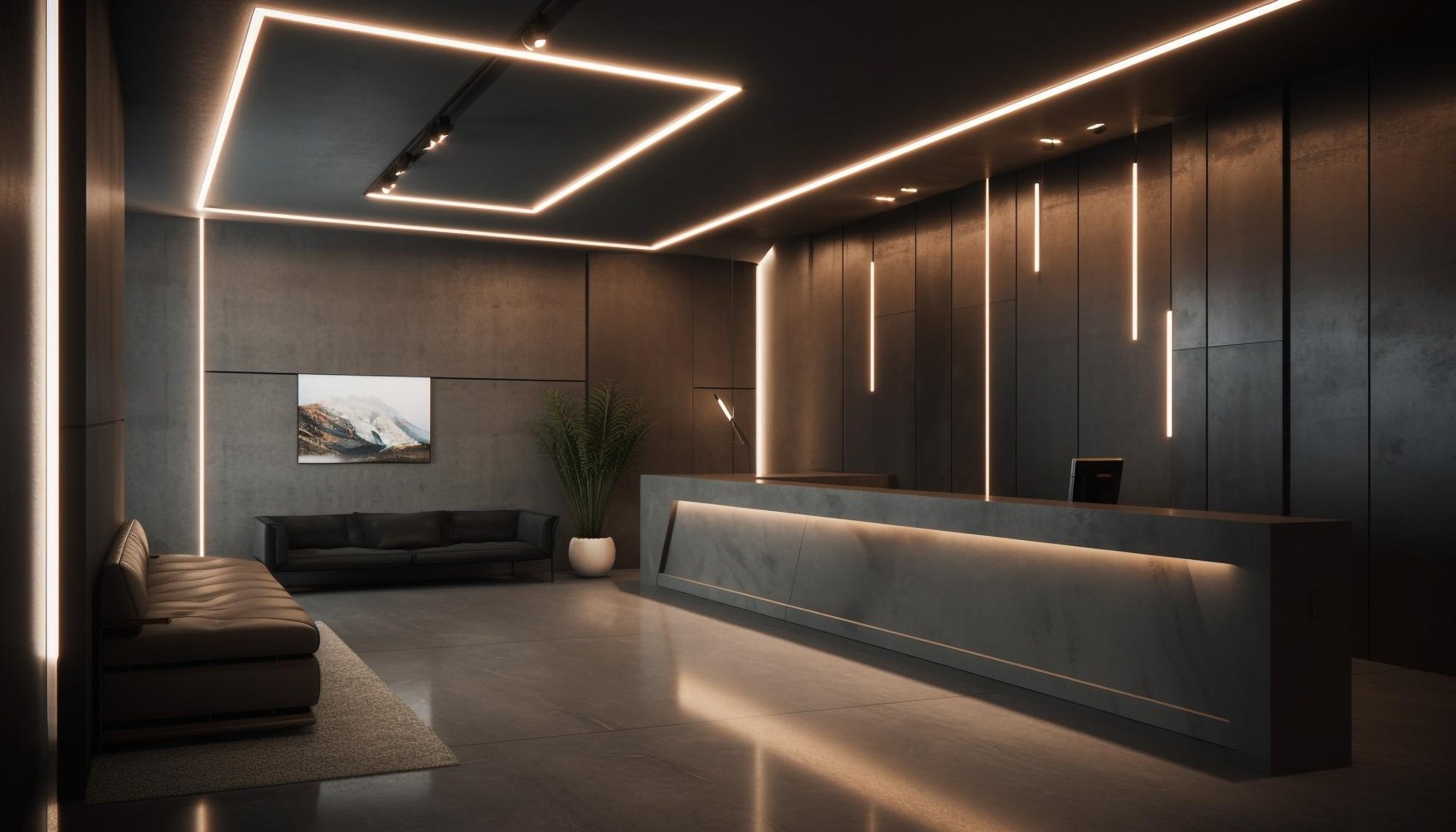
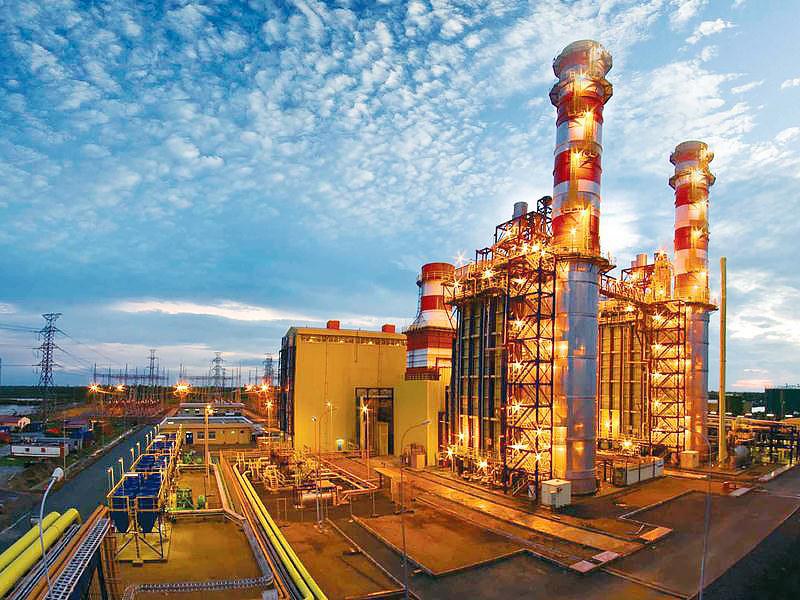
Application illustration from the iBrite catalogue; not a SuperMRO project photograph.
Independent development with continued cooperation
IBS Saigon and the MRO activities that developed into SuperMRO previously belonged to the same IBS ecosystem. Each business subsequently focused on its own strengths and direction. Operational independence remains compatible with sharing suitable opportunities, introducing customers and combining capabilities for plants and buildings. This collaboration is not an announcement of a merger or ownership change.
IBS Saigon and building-system expertise
IBS Saigon Joint Stock Company develops residential and professional lighting, lighting controls and building-system solutions. In this cooperation it contributes equipment selection and solution-delivery expertise; SuperMRO connects industrial procurement and maintenance requirements. According to the cooperation information supplied by SuperMRO, IBS Saigon is iBrite’s exclusive distributor in Vietnam, with SuperMRO supporting market development through IBS Saigon.
Introducing iBrite
The LED Collection identifies iBrite as “A Premium product of IECAS” and describes an approach combining lighting engineering with visual experience. Three application areas are buildings/workspaces, industry and hospitality. The supplied documents present complementary architectural ranges — LED strips, neon, modules and drivers — and industrial fixed, emergency and portable lighting with hazardous-area accessories. This article follows that catalogue identity rather than unrelated similarly named brands.
Light quality alongside electrical performance
Good lighting delivers light where needed, appropriate colour and comfortable viewing. The catalogue refers to CRI ≥ 90 for many architectural configurations, alongside glare, colour consistency, IP/IK and DIALux studies. Offices need task-plane illuminance and glare control; hotels need colour quality and scenes; factories need uniformity, durability and maintainability. Introductory portfolio targets are not automatically specifications for every luminaire.
COB strips for continuous lines of light
LED STRIP COB VALUE targets uniform linear light for coves, shelving, counters and interior details. The catalogue includes 24 V codes with different power and colour-temperature options and IP20 or IP67 configurations. Design also considers run length, feed points, voltage drop, aluminium heat-dissipating profiles, driver access and dimming compatibility. The visual result depends on the strip, power supply, mounting and reflecting surfaces together.
Flexible wall washers for architectural surfaces
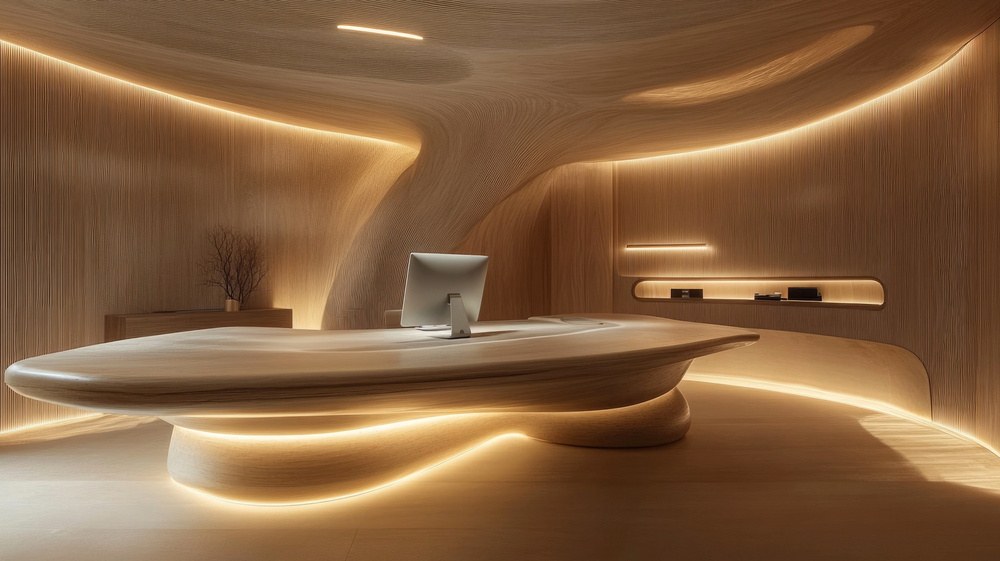
Flexible wall washers use directional optics to illuminate vertical surfaces, materials and façade or interior rhythms. Different beam angles and outdoor configurations are listed by code. Unlike cove lighting, wall washing requires attention to setback, wall height, aiming and vertical uniformity. Simulation and sample testing help avoid harsh streaks, dark gaps and exposed sources in normal sightlines.
Neon with the appropriate bending direction
The neon ranges include anti-glare, side-bend and top-bend configurations for ceiling details, outlines, signs, curves and landscape accents. Silicone housings and optical construction create continuous-looking light. Bending direction must match the installation geometry; a strip must not be forced in an unintended direction. Colour and control options also belong to specific codes rather than every member of a family.
Special environments and longer neon runs
The catalogue includes sauna, snow-room and ultra-long ranges in addition to standard configurations. They broaden options for particular temperature, moisture and layout conditions. Feed length, bending radius, water resistance, terminations and any immersion conditions must follow confirmed datasheets. Some descriptive text and code tables require length clarification before ordering, so no single run-length claim is applied across the ultra-long family.
LED modules for controlled accent lighting
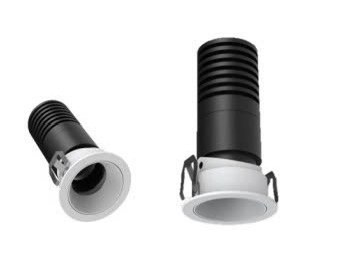
Modules allow selection by beam and output rather than wattage alone. The catalogue lists 15°, 24°, 36° and 60° optics, high-CRI configurations and optional anti-glare accessories for relevant ranges. Some modules target GU10/MR16 applications, subject to dimensions, cooling and driver checks. IB-LM50-930-12W-IP65, for example, is listed at 12 W, 3,000 K, 1,090 lm and CRI ≥ 90; those values are model-specific.
Constant-current and constant-voltage drivers
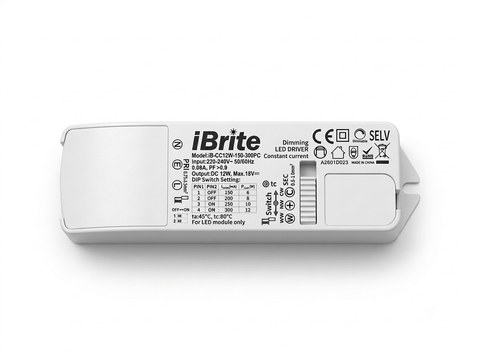
Drivers affect stable operation, dimming and maintenance. IB-CC12W-150-300PC offers 150/200/250/300 mA DIP-switch selection. Constant-voltage families include 12 V or 24 V, indoor IP20 and waterproof versions by code; IB-DPFA-60-24 is a 60 W, 24 V example. Output current or voltage, load range, thermal conditions and controllers must match. Equal wattage does not make constant-current and constant-voltage supplies interchangeable.
Controls for spaces and operating schedules
The catalogue refers to phase-cut, 0–10 V, DALI, DMX and adjustable colour temperature for applicable configurations. Dimming supports scenes and reduced output when less light is needed; zoning, schedules and sensors can avoid unnecessary operation. KNX or building-system integration requires suitable interfaces. Results depend on the tested combination of LEDs, drivers, controls and scenarios, not merely a protocol name.
Fixed iBrite luminaires for industrial environments
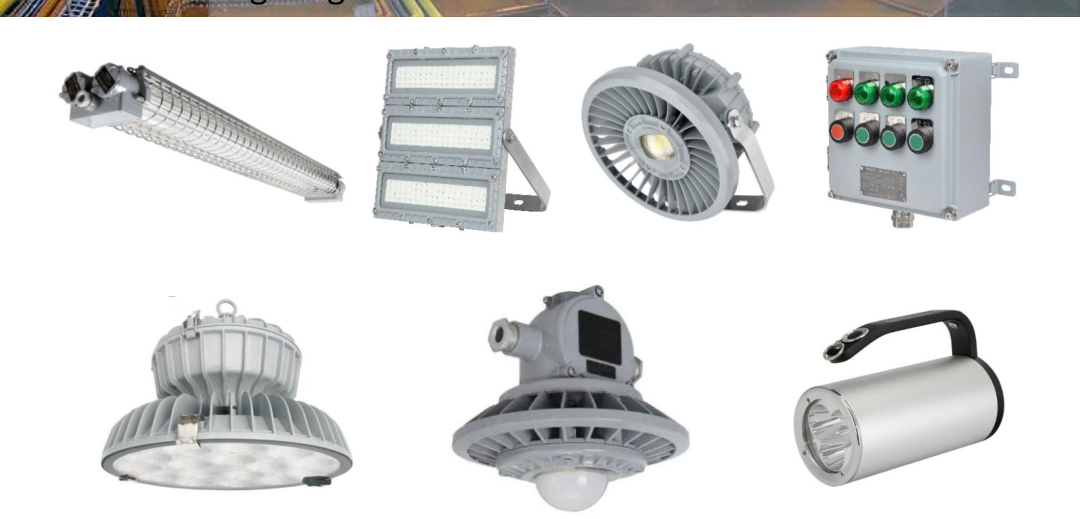
The 2026 catalogue covers linear, equipment-area and industrial or hazardous-area fixtures. IBBC5401, IBBC5402A/B and other families have their own voltage, output, mounting and Ex markings. Linear units can be assessed for walkways, platforms and lower mounting heights. Similar-looking A and B variants may serve different hazardous zones, making the exact code more important than appearance.
Higher-output lighting for equipment areas
IBBC9304P/S and IBBC9102S broaden choices for equipment, yards, workshops and higher-output duties. IBBC9304P-L100 is listed at 100 W and 12,675 lm; IBBC9102S includes modular configurations up to 300 W. Photometric data and simulation translate fixture output into illuminance on floors and equipment. Ambient temperature, distribution, support loads and cleaning access also matter throughout operation.
Emergency lighting for appropriate locations
Emergency variants combine normal and backup operation as specified. The IBBC5404J table, for example, lists 5 W, 550 lm and ≥ 180 minutes in emergency mode for the stated codes. Duration, charging state, functional testing, batteries and thermal conditions belong in the operating plan. Emergency illumination and escape-route signs perform different functions; layout must meet the building objective and the product’s approved application.
Portable equipment and mining ranges
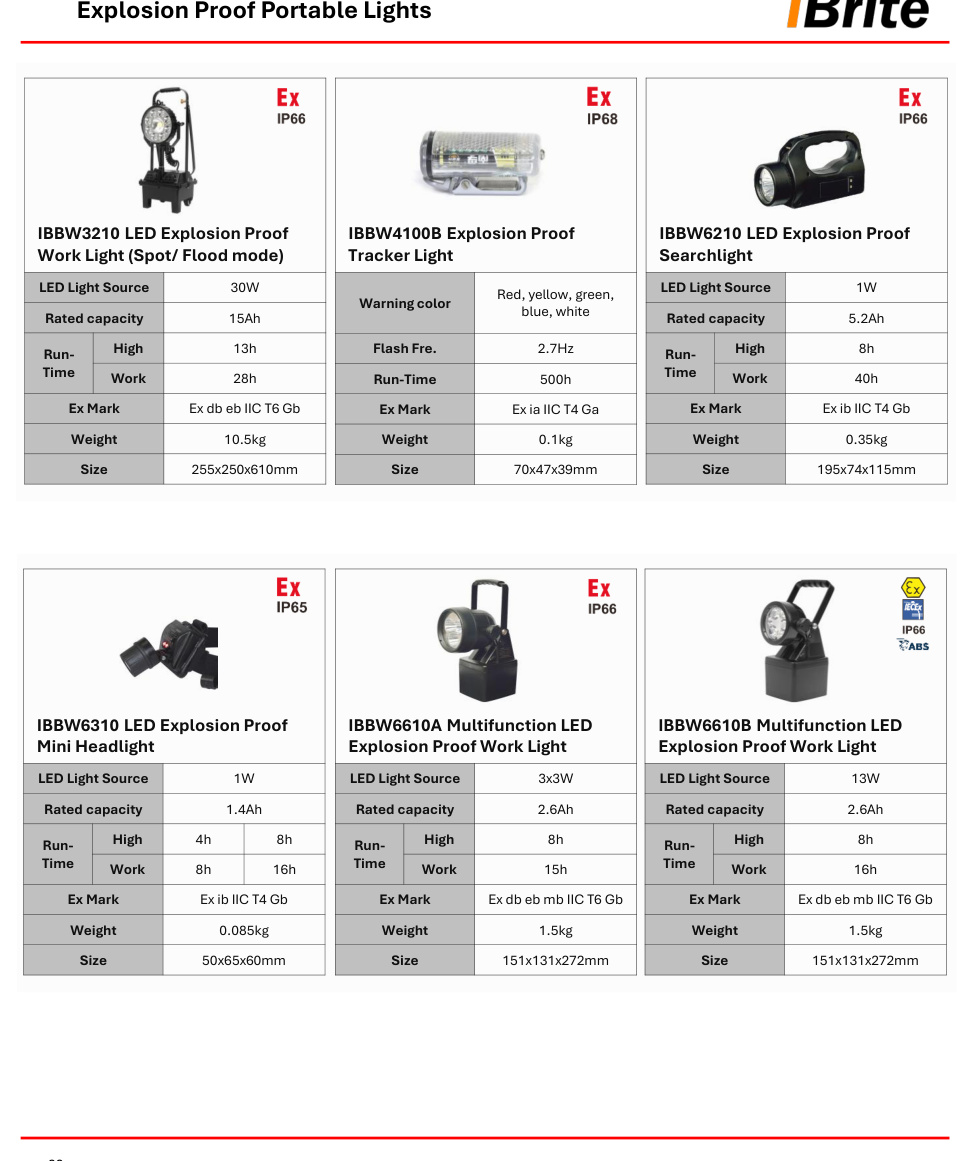
IBBW ranges include work lights, searchlights and flashlights, with spot or flood modes depending on model. They support inspection and maintenance where fixed lighting is difficult. IBDGS coal-mine products have separate specifications. Mine requirements differ from ordinary gas- or dust-zone classification; equipment and charging conditions must suit the actual location, including battery runtime and permitted charging arrangements.
Accessories complete the lighting solution
The range includes IBBHD junction boxes, IBBXJ electrical boxes, switches and connectors or sockets by configuration. Reliability depends on glands, entry threads, cables, blanking plugs, earthing and mounting as well as the fixture. Coordinated selection reduces mismatched connections and unsuitable replacements. Backup supplies, surge protection and cable routing should also be considered within the overall design.
Selected reference configurations from the iBrite catalogues
| Product code | Catalogue data | Potential application |
|---|---|---|
| IBBC5401-L2x20 | 100–240 VAC; 2 × 20 W; 4,800 lm | Linear and walkway lighting, subject to Ex classification |
| IBBC9304P-L100 | 100–277 VAC; 100 W; 12,675 lm | Equipment areas and higher mounting positions |
| IB-LM50-930-12W-IP65 | 12 W; 3,000 K; 1,090 lm; CRI ≥ 90 | Accent lighting with compatible module and driver |
| IB-CC12W-150-300PC | 6–12 W; 150/200/250/300 mA; IP20 | Constant-current driver with DIP-switch selection |
| IB-DPFA-60-24 | 24 V; 0–2.5 A; 60 W; IP20 | Constant-voltage supply for compatible loads |
Data identifies specific catalogue configurations. Current datasheets, certification and installation conditions are required for selection; this table is not a lighting design.
From Ex classification to photometric design
IP addresses dust/water ingress and IK impact resistance; neither replaces explosion-protection markings or certification. Selection needs gas or dust, Zone, group, temperature class, ambient conditions and installation requirements. Illuminance, uniformity, glare and maintenance access remain parallel design tasks. SuperMRO and IBS Saigon can coordinate surveys, load lists, samples, simulation, documentation checks and replacement planning for each location.
Hisense HVAC within the cooperation scope
Both businesses will introduce Hisense solutions to their customer networks, focusing on VRF, chillers and HVAC accessories. The supplied authorisation covers IBS Saigon’s distribution, installation and after-sales service for Hisense VRF and chillers for certain projects in Vietnam, valid from 1 October 2026 to 1 October 2028. It is not presented as exclusivity for all Hisense products or exclusive rights held by SuperMRO.
VRF for spaces with different demands
VRF varies refrigerant flow to serve air-conditioned zones and can be assessed for offices, hotels, commercial areas and plant support buildings. Hisense offers Hi-FLEXi and Hi-Smart ranges, cassette and ducted indoor units and controllers. Suitable heat-recovery configurations can provide simultaneous cooling and heating across zones. Capacity, fresh air, architecture, piping and operating conditions must be selected around the actual load.
Chillers for central chilled-water systems
Hisense offers air- and water-cooled chillers, with examples including Hi-Mod, Hi-AS and Hi-SC. Chilled-water systems can serve suitable buildings, hotels, commercial centres and technical requirements, together with terminals, pumps, piping and controls. Selection considers cooling load, supply/return temperatures, part-load performance, heat rejection, noise and redundancy. Process cooling requires separate confirmation against the equipment’s operating envelope.
Lighting and HVAC in operational planning
iBrite and Hisense serve different systems but can be assessed within one building-upgrade plan. Lighting analysis uses power, hours, illuminance and controls; HVAC uses load, occupancy schedules, part-load efficiency and environment. Compare investment, electricity, maintenance, component life and downtime. Savings should be calculated from project data rather than a universal percentage.
Coordinating a specific customer requirement
A project can start with layouts, site photographs, lighting or HVAC inventories, operating hours and priorities. SuperMRO and IBS Saigon clarify scope, verify data, select configurations and develop supply or retrofit proposals. New projects can coordinate lighting, controls and air conditioning; operating facilities can proceed by area and maintenance window. The aim is to apply each independent company’s strengths to a suitable long-term solution.